|
|
|

ILLESH FEHER: TRANSLATION IS MY INNER NEED  | Neda Gavrić | |
| |
detail from: KRK Art dizajn
ILESH FEHER: TRANSLATION IS MY INNER NEED
Interview by Neda Gavrić
Technical editing: Ilija Šaula
Illesh Feher, an expert in chemical sciences, decided to transform his passion for language and literature into an impressive body of translation work. Over the past several years, he has translated more than 4,000 poems by various authors, enriching the cultural scene and contributing to a deeper understanding of poetry among readers. His work goes beyond the technique of translation, it reflects a profound emotional connection to words, clearly visible in his seventeen bilingual books.How did a Doctor of Science find his place in the world of poetry? What motivated him to embark on this adventure?
,Ilesh reveals this in a conversation for Književni ESNAF.
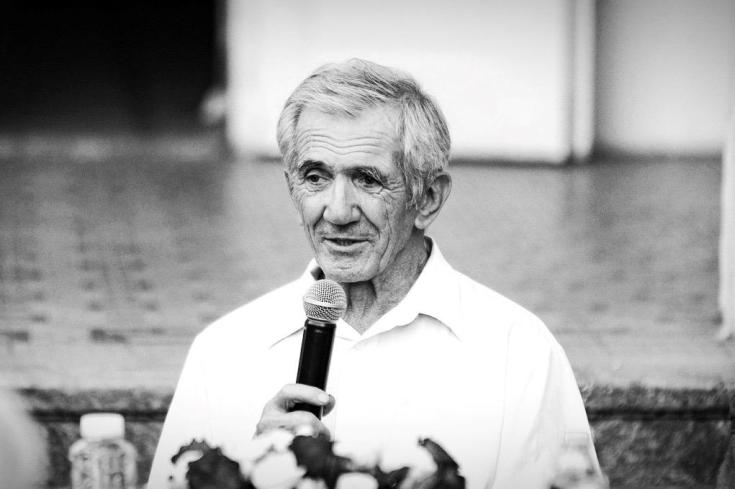 Illes Feher
To help the readers of Književni ESNAF get to know you better, how would you briefly introduce yourself?
I was born in Kastav, behind God’s back, somewhere in Istria. That territory belonged to Italy at the time, then to Yugoslavia, and now it is part of Croatia. Did the fate of my birthplace leave a mark on my life path? Perhaps, because my life has been filled with contradictions. I was hailed as a genius and dismissed as a charlatan, praised as an expert and scorned as a drunkard. Tennis and boxing got along quite well until an early injury ended my sports career. Biochemistry and science walked hand in hand with translation.My father was a pharmacist from a peasant family. That is how, in early childhood, I came to know the life of peasants, and through my mother’s family, the life of fishermen. During my childhood, I didn’t go from one summer resort to another, instead, I was a shepherd on a farm near Temerin at my uncle Lajoš’s place, or I rowed from dawn with fishermen toward Kanjiža, and on better days to Nadrljani, where we cast the nets and drifted down to Senta.I often ask myself: who received more from fate?
Me, who got used to work from the age of six and saw the sea for the first time at fourteen on a school trip, or my son, who from the age of four swam in the salty blue with his kindergarten friends?But what does daily struggle mean? I believe I was fortunate, and I remember my childhood with joy. As a four‑year‑old at my grandmother’s in Temerin, I squeezed the necks of ducklings with the greatest delight. I was not praised for that. When my cousin and I skipped Sunday mass and ended up in the marsh, where we sank into the mud, Uncle Lajoš gave us a good beating, dear God. And the fact that I was the one who sewed wide skirts onto the village women during midnight mass, that was never discovered.So, I was an exceptionally well‑behaved child.But one thing was never problematic learning.
As an eight‑year‑old, I asked my mother: “Can you study peasantry at university?”
As if I had asked something impossible.
“You’re not planning to become a peasant, are you?” she asked.
“That would be the right thing,” I told her.
“For heaven’s sake, why?”
“Because they’re allowed to swear.”My mother was stunned; my father said nothing, but his eyes sparkled.
From him I learned another truth: “Son, don’t argue with women, one way or another, they’ll be right.”I am grateful to my high‑schoolteachers. Each in their own way, almost without exception, was a true personality. Besides lexical knowledge, they demanded independent thinking. Even our mischiefs were punished in ways we found acceptable.I especially remember my Hungarian teacher, Jenő Dancsó. We didn’t have mandatory reading, but reading itself was mandatory. Every other week we had to report what we had read. I recited by heart. Which poets first drew you toward poetry and its translation?
Poetry has followed me since early childhood, and since it already exists in my life, I want to share what I love with people of other nations, perhaps it will bring them joy as well.Which poet influenced me, which ones pulled me into the sphere of poetry?
It seems to me that it was poetry itself, simply: POETRY.For me, the word literature means poetry.
The last novel I read, only God knows when that was. Invented stories are not for me.
Oh yes, there is one exception: Ivo Andrić’s Jelena, the Woman Who Is Not There.
I would even attempt to translate it if I had it in electronic form on my computer.And the fact that in bookstores, out of 100 books sold, perhaps only one is a book of poetry, that is another story, a reality.
And the reality is also that we are now floating on the waves of poetry, just as poetry itself is a kind of floating.Are verses fragments of stopped time?
Let philosophers think about that.Some verses I always carry with me.
In summer, when I drive past ripe wheat fields, I repeat endlessly the lines of Gyula Juhász: What Was She Like:
Her golden hair I no longer remember,
But I know the fields shine gold
When summer ripens in yellow grain,
And in that yellow glow I feel her again.
But living in me just as strongly are The Raven, The Black Man, Mostar Rains, The Circle by Irfan Horozović, and It Hurts So Much (Nagyon fáj) by Attila József. What inspired you to devote yourself to translation and literature?
Translation is my inner need.If someone asks why a biochemist, a scientific researcher, dedicates part of his free time to translation,a task doomed to failure from the start,then I call upon the famous mountaineer Hillary for help.
When he was asked why he set out to conquer Mount Everest, he simply replied:
“Because it is there.”Hillary at least knew what kind of challenge Everest represented.
And what kind of challenge translation represents for me,a scientific researcher,something that is already a challenge even for a professional translator or writer.The well‑known Hungarian poet and brilliant translator Dezső Kosztolányi wrote in the preface to the second edition of his selection of European poetry Modern Poets (1921) a sentence often quoted:
“To translate is the same as dancing with your feet bound in chains.”And if we consider the essential differences between Serbian and Hungarian, the challenge becomes even greater.
Hungarian has no grammatical gender, does not use auxiliary verbs to form past or future tenses, has four cases instead of seven, uses definite and indefinite articles, and its word order is reversed compared to Serbian.When those who know that I have been translating poetry for decades ask me:
“Why don’t you write your own poems?”
I answer in three words:
“Because I’m a biochemist.”“And why couldn’t a biochemist write, when many writers, for example doctors, do?”
“Because that biochemist simply wasn’t born to write.”In my entire life I have written only one poem, I sent it to a friend as an Easter greeting:
Do we resurrect?
Do we renew ourselves?
If you feel, in the morning rays of the sun,
in drops of rain,
in the toughness of roots,
in the majesty of time passing,
in the calm of sunset,
in human living,
the possibility of a new beginning,
then yes,
WE RESURRECT.
WE ARE RENEWED. How do you choose the poems and authors you want to translate?
If I had to single out one poet who has held a special place on my shelf since my youth, it would be Miklós Radnóti.
Perhaps his verses are fragments of stopped time, and now I want to share something deeply personal with the readers.I began translating during my student days because without Radnóti, I didn’t even know how to court a girl.
Can that be called a fragment of stopped time?Miklós Radnóti and the Bor NotebookThe Bor Notebook contains ten poems Radnóti wrote from the moment he was taken to the Heidenau labor camp (near Bor) until his death.
Under each poem, the date and place of writing are noted, making it clear how long the camp existed, when the retreat began, and which route the prisoners were forced to march.Death found him near Abda, close to Győr, together with more than sixty fellow prisoners, all buried in a mass grave.
Only a year and a half later, during exhumation, it became clear that Radnóti was among the murdered.
The Bor Notebook was found in his pocket. What was the turning point in your translation work?
The turning point in my translation career was my encounter with the Banja Luka literary circle.I spent 20 wonderful years in Bosnia (1970–1989), ten years in Bosanska Gradiška and ten in Banja Luka.In Banja Luka, not entirely by chance, I met Irfan Horozović, and through him many local writers.
They accepted me as a translator, perhaps also because, except for Stevan Martinović-Pišta, no one translated to and from Hungarian.My first translations were published in Putevi.
Later came Most, Lipar, Orbis, Magyar Szó, Hét Nap, Üzenet.One of my earliest translations in Putevi was “The Blackberry King” by László Nagy. You often mention your good relationship with the poets of Banja Luka. What contributed most to that mutual impression?
We were sincere friends.
We collaborated, and they helped me immensely, they didn’t allow me to drown in my insufficient knowledge of the then Serbo‑Croatian language.
Friendships were formed that still live today.Something eternal:
My translation of “Who Will Carry Love Across” by László Nagy is a shared memory of Ranko Risojević, Stevan Martinović, Ismet Bekrić, Irfan and Ajnúša Horozović, Predrag Bjelošević, and me, from one unforgettable night spent at my place. Which languages do you most often translate into, and what inspired you to choose those languages?
I primarily translate poems by Serbian, Croatian, Bosnian, and Montenegrin poets into Hungarian, and poems by Hungarian poets… into which language, I wonder?Instead of an answer:
I mastered Serbo‑Croatian during my studies.
I know the ekavian, ikavian, and ijekavian variants.
Since I learned the language in Zagreb and lived in Bosnia, where all three peoples use the ijekavian pronunciation, I kept that pronunciation in everyday speech, while in translation I use ekavian.Let the readers decide into which language the text has been translated. How do you approach translating poetry, considering its essential nature, rhythm, and emotion?
Choosing the poem takes the most time.
First and foremost, I must feel the poem.By nature, I react emotionally,even in scientific work.
What does that mean?
Let me explain with an example from science.Mendeleev described the creation of the periodic table like this:
“In a dream I saw a table where all the elements fell into their proper places. Upon waking, I immediately wrote it down; later I had to correct only one element.”Once I feel the poem, I try to imagine how to translate its key part.
Sometimes that is the title, sometimes a detail in the middle, sometimes the ending.I openly admit, I do not like rhymed poems.
Sometimes the poem itself feels forced, and as for translation: except in rare cases, it is impossible to translate rhyme without “violating” the language.
And violating the language is unacceptable to me.That does not mean I have never translated a rhymed poem.
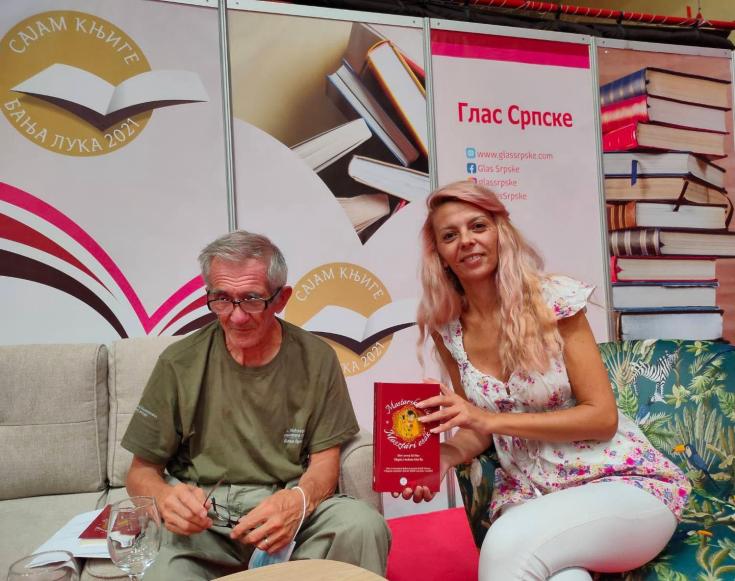 Illes Feher in conversation with journalist Neda Gavric
Do you have a criterion that helps you decide which work deserves your attention?
I emphasize:a) I translate only what I like.I can afford that because my profession, medical biochemistry, has provided me with a solid life.
If I had to live off translation, I wouldn’t even have pocket money.b) I primarily love poems, not poets.If I like a poem, even if the author is unknown to most, I translate it.
Perhaps in that way I save the poem from oblivion.Selections such as Silver Bridge, Banja Luka Manuscripts, Mostar Rains, and A Glimpse into Contemporary Hungarian Poetry contain many names unknown even to connoisseurs. Can you share the experience of your first translation?
I grew up in Senta, where even today 80% of the population is Hungarian.
As children, we who thought we knew everything made a sport out of not knowing Serbian.I was about ten when a Serbian family moved into the neighboring house.
Their son, Fico, was my age.
We became friends, and my parents were delighted, finally I would learn Serbian.
He learned Hungarian too.In high school, our Serbian teacher didn’t know Hungarian, and we didn’t know Serbian.
Communication went through “Kazi,” a classmate from a mixed marriage who knew both languages.
Our grades reflected the situation.When I arrived at university, I knew only: “good morning,” “good day,” “give me bread.”So in my youth I read exclusively in Hungarian.
I discovered Hungarian poetry and, through excellent Hungarian translators, world poetry.
From Serbian poets, I knew only Branko Radičević and Danilo Kiš.As I said: without Radnóti, when I began to think seriously about translation alongside my scientific work, I tried to translate the poems that had accompanied me since youth.The only criterion:
Was my modest knowledge of Serbo‑Croatian sufficient to translate a given poem?
Thus, at the beginning of my translation career, I translated Hungarian poets.
Only later, in the late 1980s, came my first translations of Banja Luka poets into Hungarian. How does your translation process look?
To give readers insight into how I work daily, how I reach new ideas and create new books, I must reveal the secrets of my translation “kitchen.”On my desk (computer) I always have several constant names,my chosen ones.
I like their poetry and aim to translate enough poems for a book.For me, enough is 55, 66, or 77 poems by one author.By nature, I cannot focus on only one name.
I translate several chosen authors in parallel.
I always have enough of them that I translate at least one poem from every week.Besides them, when the mood strikes, I search online for new names.A small secret:At the printing house right now is a selection of poems by Biljana Milovanović Živak.
The publisher promised that two collections, Living Serbian Poetry and Living Hungarian Poetry,each with 111 poems by 111 authors, will be published by the Belgrade Book Fair.Waiting for publication are selections by Predrag Bjelošević and Zoran Bognar.I have translated 33 poems each by Vlasta Mladenović, Snježana Rončević, and Dušan Gojkov, waiting to be shaped into books.I promised myself: by autumn, it will all be finished.On my desk now are:
Miodrag Jakšić, Nenad Grujičić, Željka Avrić, Barbara Novaković, Obren Ristić, Hajnal Anna, Bíró Tímea. You mentioned you don’t like rhymed poems. Yet you translated some. Can you tell us more?One such poem is “Nagyon fáj” (It Hurts So Much) by Attila József.
A cursedly difficult task.First, the title, which is also the refrain:
Nagyon fáj.
Literal translation: it hurts a lot.
Use that, and you kill the poem.Danilo Kiš translated it as “Boli”, and in the refrain: boli, boli.
Thomas Kabdebo, English: “It deeply hurts.”
Daniel Muth, German: “Es schmerzt mich.”I could be proud of my solution, because by generally accepted criteria, it is better than the others.One afternoon, Irfan and Ajnúša were my guests, on the table, along with fish paprikash, was Tokaji wine.
During our conversation, we reached Attila József and Nagyon fáj.
I explained the meaning, the sound, and admitted I had not found an adequate translation.Suddenly Irfan slapped his forehead and asked:
“Why couldn’t it be, ‘Bol je to’?”Yes. Brilliant.And I always emphasize:
The title and refrain “Bol je to” in my translation of Attila József’s poem is Irfan Horozović’s idea. Could you share more information about your blog where your translated poems are published?My blog Ezüst híd – Silver Bridge carries the title of my first bilingual book.
There I publish freshly translated poems.
When a poem is later selected for inclusion in a book, I always reread it through the eyes of the strictest critic, someone else’s eyes.
That way I can notice mistakes, and after revising the poem, I send it to my proofreaders.
How do you choose themes for selections such as Mostar Rains?
In the book Banja Luka Manuscripts, I used the term anthology.
It was used only because the editor insisted.
I do not like that word, and I do not use it.Selections always reflect my personal view of poetry, but they cannot be anthologies, because an anthology is a whole, and I do not consider myself knowledgeable enough in either Hungarian or Serbian poetry to dare assemble a true anthology of any literary region.That is why I use the term selection. To what extent do you think the role of a translator is crucial in preserving and promoting cultural heritage? How do you see your own role in this process?
In one interview I was asked:“If I told you that your translations of Serbian poets and writers into Hungarian have indebted the Serbian nation to such an extent that in the future your name will be synonymous with a Serbian cultural ambassador in Hungary, would you believe me?”
My answer was:
No, but I would like it to be so.It sounds beautiful to say that a translator plays a key role in preserving and promoting cultural heritage.
There is some truth in that. Some of the books you translated have received prestigious awards. Could you mention them here?
I will highlight two bilingual editions:Novi čovek – Új ember by Zoran Bognar, published in BudapestÜresség – Emptiness by István Turci, published in Belgrade
These are monumental works.
Such achievements can be translated only if the translator sleeps together with the verses.Around the same time, I began translating both Novi čovek and Emptiness.
At first, I found only fragments online and translated those.
In both cases, something felt strange, I sensed something and began searching further.When I was nearing the end of both translations, I thought:
What if I suggested to Zoran that he publish István’s poem, and to István that he publishes Novi čovek?Letters followed, through me, and behold: both books began to live their own lives.I met Zoran for the first time in Subotica in 2022, when we traveled together to Budapest for a triple promotion: Mostar Rains, Novi čovek, and Emptiness.
Arriving in Budapest, we finally shook hands with István in person and continued as if we had known each other forever.A pleasant fact:
Based on my translations, István Turci received the Open Book Award of the Association of Writers of Republika Srpska in 2022, and in 2024 the International Branko Radičević Award given by Brankovo kolo in Sremski Karlovci.Emptiness by István Turci has also come to life in Albanian.
Based on my Serbian translation, if I am not mistaken, Demo Berisha translated it into Albanian. What is the reality of literary promotions?
Pécs, October 19, 2017, 6 PM, Cultural Center
Promotion of the bilingual edition of selected poems by the great Hungarian poet Lajos Kassák: The Struggle with the Angel.
Together with me, my wife, two representatives of the publisher, and one reciter,
total number of attendees: 11.Budapest, May 12, 2022, House of the Hungarian Writers’ Association, 6 PM
The already mentioned triple promotion of bilingual editions.
Together with the authors, the host, me and my wife, one reciter, and a photographer,
total number of attendees: 14. All the poets whose work you have translated are deeply grateful to you and often mention you. How much does such feedback mean to you?
Since I am speaking about my decades‑long translation work, I want to thank the people who encouraged me from the very beginning.Editors to whom I am grateful:Irfan Horozović, Karolj Habram †, Marija Habram, Éva Hajnal, László Markuš, Katica Šcur, Péter Kókai, Šimo Ešić, Anđelko Zablaćanski, Zdravko Kecman †, Tibor Pinter †, Gábor Cseke †, Tamás Gergely, István Turci, Attila Jász, Zoran Bognar, Živko Nikolić, Miodrag Jakšić, Nenad Grujičić, Dušan Gojkov, Milan Orlić.For valuable advice and excellent proofreading:Milica Mitraković, Adnana Karahasanović, Draginja Ramadanski, Dijana Tiganj, Željka Janković, Mišo Kovač †, Faiz Softić, Milica Milosavljević, Željka Janković, Snježana Rončević, Jelena Glišić, Biljana Milovanović‑Živak, Valentina Novković, Marija Šimoković, Nikola Popović, Gábor Turi, János Szabó †, András Ady, Péter Sebestyén, Péter Kókai, Tímea Moger.I hope I have not forgotten anyone.I also thank my wife, Gyöngyi Feher Arkosi, for her continuous support of my translation work.
|