|
|
|

 | Simo Jelača | |
| |
detail from: KRK Art dizajn
SOLAR PLANETARY SYSTEM
Dr. SIMO JELAČA
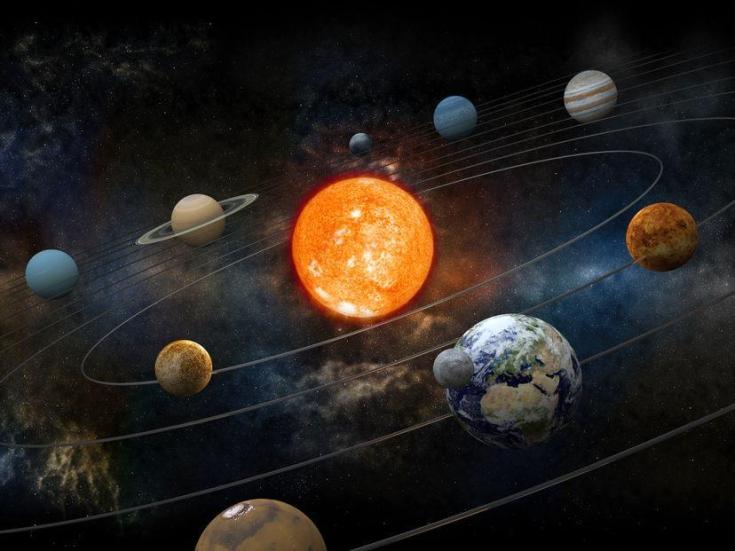
Our Solar Planetary System consists of one Sun, eight planets, five dwarf planets, more than 290 natural satellites (moons), over 1.3 million asteroids, and about 3,900 comets. All of these objects are located in the Milky Way Galaxy, in its Orion Arm. The Solar System moves through the galaxy at a speed of approximately 828,000 km/h and requires about 230 million years to complete one orbit around the galactic center.The planets of the Solar System are Mercury, Venus, Earth, Mars, Jupiter, Saturn, Uranus, and Neptune. The dwarf planets are Pluto, Ceres, Makemake, Haumea, and Eris. Most planets have natural satellites, and the system also contains a vast number of asteroids and comets.The diameters of the planets are as follows: Mercury 4,880 km, Venus 12,104 km, Earth 12,756 km, Mars 6,792 km, Jupiter 142,984 km, Saturn 120,536 km, Uranus 51,118 km, and Neptune 49,528 km. The diameter of the Sun is approximately 1,392,700 km, nearly ten times larger than Jupiter. Pluto has a diameter of about 2,377 km.
Distances from the Sun are expressed in astronomical units (AU). One AU is defined as the average distance between Earth and the Sun, which is 149,597,870 km. The planets are located at the following average distances: Mercury 0.39 AU, Venus 0.72 AU, Earth 1.00 AU, Mars 1.52 AU, Jupiter 5.20 AU, Saturn 9.58 AU, Uranus 19.22 AU, and Neptune 30.05 AU.
The Sun is a star at the center of the Solar System. It consists of hot plasma made primarily of hydrogen and helium. It produces energy through nuclear fusion and emits it in the form of visible light, ultraviolet radiation, and infrared radiation.Mercury has an extremely thin atmosphere. Venus has the densest atmosphere among the rocky planets, composed mainly of carbon dioxide. Its surface contains hundreds of volcanic structures.Earth is the only known planet with stable liquid water on its surface and the only known planet that supports life. Water covers approximately 70.8% of its surface. Earth’s atmosphere consists of about 78.08% nitrogen, 20.95% oxygen, 0.93% argon, and approximately 0.04% carbon dioxide.
Mars is known as the “Red Planet” due to iron oxide on its surface.Jupiter is the largest planet in the Solar System and has a mass approximately 2.5 times greater than the combined mass of all other planets.Saturn is a gas giant with an average density lower than that of water.Uranus and Neptune are classified as ice giants because they contain large amounts of water, ammonia, and methane in the form of high-pressure ices.The planets are divided into two groups: inner planets (Mercury, Venus, Earth, and Mars) and outer planets (Jupiter, Saturn, Uranus, and Neptune).Average planetary temperatures are: Mercury 167°C, Venus 464°C, Earth 15°C, Mars −65°C, Jupiter −110°C, Saturn −140°C, Uranus −195°C, and Neptune −200°C.
DAYS AND YEARS OF THE PLANETS
A planetary year is the time required for a planet to complete one orbit around the Sun. Earth completes one orbit in 365.2422 days.Orbital periods:
Mercury 88 days, Venus 224.7 days, Earth 365.24 days, Mars 687 days, Jupiter 11.86 years, Saturn 29.46 years, Uranus 84 years, Neptune 164.8 years.A planetary day is the time required for a planet to complete one rotation around its axis:
Mercury 58.6 days, Venus 243 days, Earth 24 hours, Mars 24 hours and 37 minutes, Jupiter 9 hours and 56 minutes, Saturn 10 hours and 33 minutes, Uranus 17 hours and 14 minutes, Neptune 16 hours and 6 minutes.
CONDITIONS FOR THE EXISTENCE OF LIFE ON PLANETS
The basic conditions for life are biogenic elements, energy sources, liquid water, a suitable atmosphere, and stable environmental conditions. Even the simplest forms of life require water, energy, and chemically favorable conditions.Liquid water is the key requirement for life. Life can exist within a temperature range of approximately −15°C to +122°C. In addition to water, important factors include energy sources and the presence of elements such as nitrogen and carbon dioxide. A planet must be located at an appropriate distance from its star in order to maintain liquid water on its surface or in its interior.
|