|
|
|

WHO WE ARE, NOT WHAT WE ARE  | Ilija Šaula | |
| |
detail from: Foto: Biljana Mitrović
Who We Are, Not What We Are
Ilija Šaula
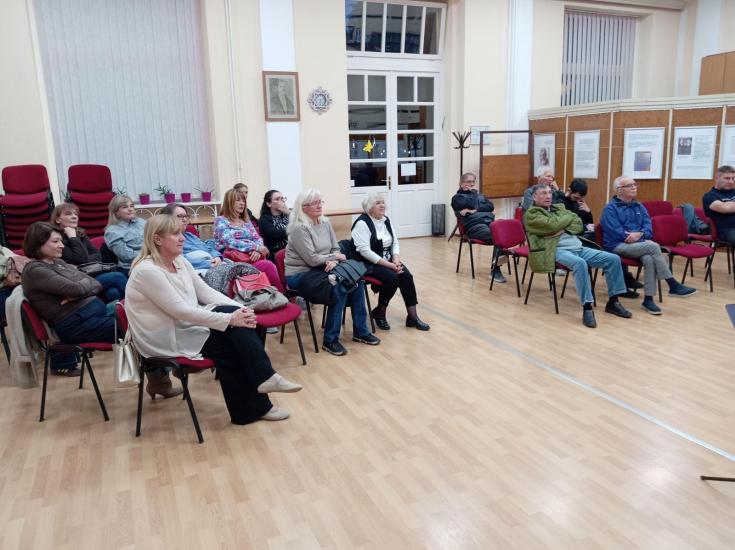
“This coming Thursday, October 15, I shall rise again in Sremska Mitrovica, in a library, among books, at the presentation of my essays collected in three volumes. We shall talk about many things, but most of all about you, dear fellow human being, who will come to listen and join us in conversation.”That was how I announced my meeting with readers, never imagining that those very words would become the most fitting introduction to a conversation about what it means to be human. Marijana, the moderator of the literary evening, recognized something in them that she wished to share with the audience. She opened the event with those words, and I soon realized that we had gathered around a question that accompanies each of us, although we rarely ask it of ourselves: who are we, rather than what are we?We discussed my books Toward Awakening, Horizons of Thought, and The Return to Humanity — Essays for Homo Deus. We spoke about consciousness, knowledge, freedom, progress, and responsibility. The audience listened with particular attention to the reflections of editor Milena Blagojević, whose interpretation formed a bridge between the writer, his books, and their readers. Through the balance of her observations and her understanding of the essence of the written word, she managed to weave an invisible network in which we all recognized ourselves, each at our own point of connection, united by a common thought yet free to experience it in our own way. Into that invisible web of consciousness, Sremska Mitrovica's singer-songwriter Hajrudin Durmanović wove his own threads, as his choice of melodies and words revealed the mysterious bond between music and humanity's communion with the cosmos, bringing our thoughts and feelings into a harmony that reminded us why every human being on this planet deserves to be seen as a star, rather than merely a conscious primate.As I listened to her, I was overcome by an unusual feeling. It was as though I were no longer attending a presentation of my own work, but a gathering devoted to humanity, where I was both guest and host. I found myself in a kind of in-between space, somewhere between what had been written and what was being spoken, between what I had intended to say and what others had discovered in my words. It was a precious experience, for I felt how a book, once it reaches its readers, begins to live a life independent of its author.As the evening unfolded, the distinction between those who spoke and those who listened gradually faded. Everyone could recognize something of their own experience in the thoughts being shared. By the end, it seemed to me that we had grown closer to one another than we had been at the beginning.The modern human being carries a burden that, to a considerable extent, we have created ourselves in our efforts to live better, more securely, and more beautifully. Obligations, expenses, responsibilities, expectations, and the constant need to move forward fill our days. In this daily struggle, we easily forget ourselves as individuals. We know what we must do, what we are expected to achieve, how much we owe, and how much we still lack, yet we increasingly fail to find the time to ask who it is that bears all these burdens.The desire for a better life is not the problem. Material progress, knowledge, and technological achievements are precious fruits of human creativity. The problem arises when human beings become servants of their own accomplishments, when life begins to serve what we have created instead of allowing our creations to serve life.That is why I do not understand the return to humanity as a return to the past. I am not calling for the rejection of civilization, nor for the recovery of some lost age. I speak of a return to the essence of being human: our capacity to think, feel, understand, love, create, and accept responsibility. I speak of a consciousness that must mature alongside the power humanity acquires, so that our physical and psychological, material and spiritual development may form a harmonious whole.Humanity, entrusted with the care of this planet, cannot build its future solely upon what it possesses and controls. Our greatest responsibility begins with our relationship to our own humanity. Only when we understand ourselves can we more fully understand the world to which we belong and our place within it.Perhaps that is why our conversation in Sremska Mitrovica felt so genuine. We weren't searching for final answers, nor were we trying to persuade one another that our views were correct. We gave people an opportunity to speak about being human, without having to define themselves through titles, professions, possessions, or social standing.As I said goodbye to those gathered that evening, I carried with me the feeling that, for a brief moment, we had all set aside something of the weight of everyday life. We had not changed the world, but perhaps we had changed the way we would look at ourselves and one another the following day.We do not have to return to where we began. It is enough, along the path we travel, to rediscover the person for whose sake we set out in the first place.
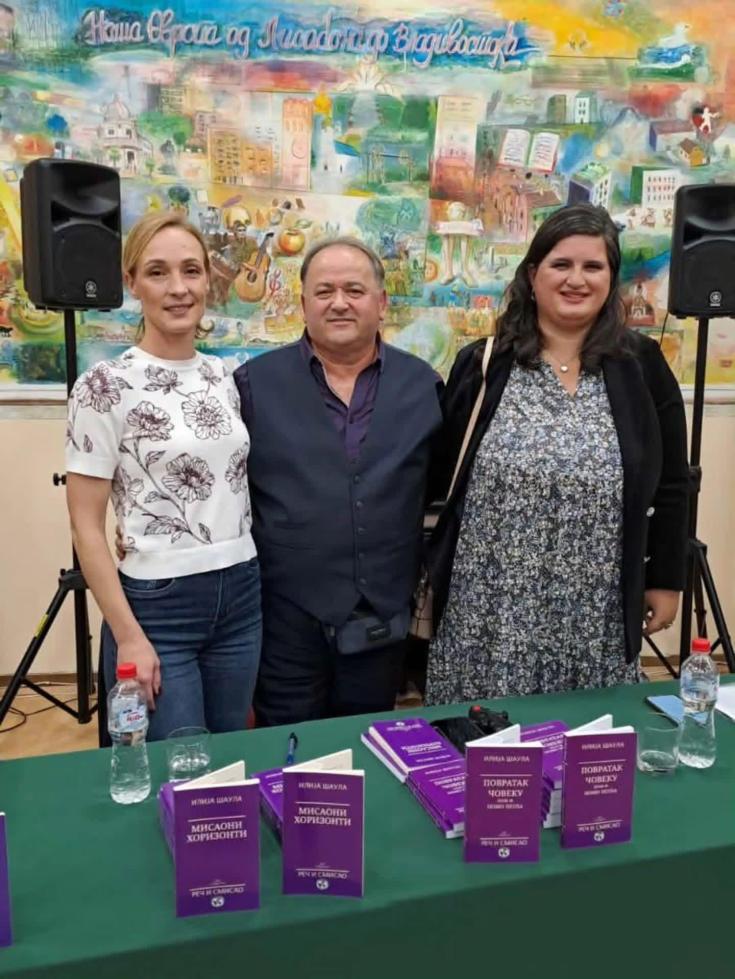 Маријана Јаковљевић, Илија Шаула, Милена Благојевић Фото: Биљана Митровић
|